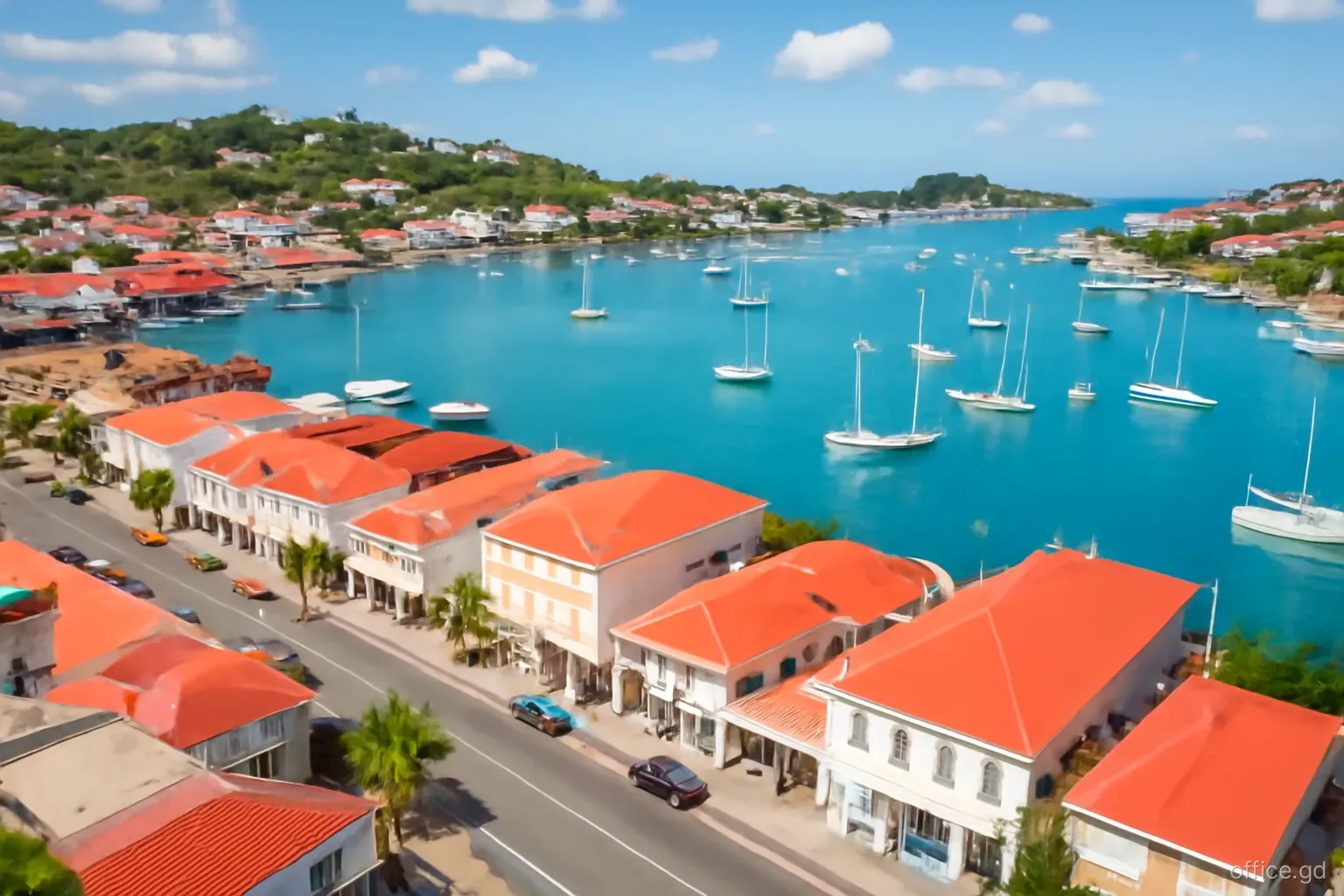
Grenada's commercial life is concentrated in a small arc of the south-west: the capital, St George's, and the busy corridor running south through Grand Anse and Morne Rouge towards True Blue, Lance aux Epines and the airport at Point Salines. Most offices, banks, professional firms and government departments sit within a few kilometres of each other, yet the choice between them makes a real difference to clients, staff commutes and daily routine.
Grenada has no large office towers or business parks in the way bigger economies do. Space tends to come as floors or suites in mixed-use buildings, rooms above shops, converted houses and units in small plazas. This guide compares the main areas on the factors that matter in practice: who your visitors are, traffic and parking, access to government offices, and the kind of buildings on offer. Rents vary widely with condition, size and location, and are negotiated rather than published, so treat any figure you hear as a starting point for discussion.
St George's town: close to government and the courts
The capital remains the natural base for anyone who deals frequently with government, the courts and the legal profession. Ministries, statutory bodies and many attorneys' chambers are in and around town, as are older banks and insurance offices. A law practice, a customs broker or a firm handling licences and permits will spend less time in traffic with an office near the Carenage, Lagoon Road or the streets climbing above them.
Buildings here are often older, sometimes historic stone or brick structures repaired after Hurricane Ivan in 2004, with offices on upper floors above ground-floor shops. Character is high, but so are the practical questions: stairs instead of lifts, limited air conditioning capacity, older wiring and roofs that need checking. Newer buildings exist, particularly along Lagoon Road and on the edges of town.
Parking is the main weakness. Town streets are narrow and steep, and on-street spaces fill early. If clients will drive to you, confirm whether the building has dedicated parking or an arrangement nearby. Staff who rely on route buses will find St George's the easiest place to reach, as most routes converge on the town terminals.
Grand Anse and Morne Rouge: the commercial corridor
The stretch from the edge of St George's through Grand Anse to Morne Rouge has become the island's busiest commercial area outside the capital. Shopping plazas, supermarkets, banks, restaurants, hotels and modern office buildings line the main road. For businesses serving tourists, expatriate residents, students or the general public, this corridor puts you in front of more passing traffic than anywhere else.
Buildings are generally newer, with more reliable air conditioning, parking lots and ground-floor access. Small plazas often combine retail units with offices upstairs, which suits service businesses such as clinics, insurance agents, real estate firms and accountants. Demand is steady, so good units do not stay empty long.
Traffic is the trade-off. The road between St George's and Grand Anse can be slow at morning and afternoon peaks and around school times. An office in Grand Anse is convenient for clients living in the south, less so for frequent trips to government offices in town. Visit the location at eight in the morning and at four in the afternoon before signing. Notice also where the nearest bank branches and supermarkets are, since staff run errands at lunchtime.
True Blue, Lance aux Epines and the airport side
Further south, True Blue is shaped by St George's University, whose campus draws students, faculty and the businesses that serve them. Lance aux Epines is primarily residential, with marinas and some professional offices in converted houses. The area around Maurice Bishop International Airport and the Point Salines peninsula is home to businesses linked to aviation, logistics and hospitality.
For a company whose staff and clients live in the south, an office here can mean short commutes and a quieter working environment. Some consultants, remote teams and small firms operate from villas or converted homes, which often have more space and parking than town offices. Check whether a property in a residential neighbourhood can lawfully be used as an office; change of use may need approval from the Planning and Development Authority, and some developments have covenants restricting commercial use.
The south is less convenient for walk-in trade from the wider island and for staff relying on public transport from the north and east, where bus connections typically route through St George's.
Outside the south-west
Grenville. The main town on the east coast and the commercial centre for St Andrew, the largest parish. Rents are generally lower than in the south, and a business serving the east and north of the island, such as agriculture suppliers, financial services or retail, can reach customers who would otherwise travel to St George's.
Gouyave, Sauteurs and Victoria. Smaller towns on the west and north coasts with modest commercial space, often ground-floor units in family-owned buildings. Suitable for local services and branches rather than head offices.
Carriacou. Hillsborough is the commercial centre of Carriacou, with Petite Martinique served from there and by its own small community. Hurricane Beryl caused severe damage in July 2024, and the availability and condition of commercial premises since then should be checked directly before making plans.
Rural and hillside properties. Some businesses choose a house in the country for space and calm. Check internet availability at the exact address, road access in heavy rain and backup power before committing.
Questions to answer before choosing an area
Location decisions in Grenada are often made on instinct or on where the founder lives. A short list of questions helps make them deliberately:
- Where do most of your clients or customers live, and how will they reach you?
- How often will you need to visit government offices, the courts or banks in St George's?
- Where do your staff live, and can they reach the office by route bus if they do not drive?
- Is there parking for staff and visitors, and is it secure after dark?
- Does the building have reliable air conditioning, a generator or space for one, and water storage?
- Which internet providers can serve the exact unit, and at what speeds?
- How did the building fare in past storms, and is it above flood-prone ground?
- Can the use you intend be carried on lawfully at the address?
Mistakes people make with office location
The most common mistake is underestimating traffic and parking. A two-kilometre difference on a map can mean twenty minutes at peak times, and clients who cannot park tend to go elsewhere. The second is assuming that an attractive building has the services a modern office needs: older premises may not support the air conditioning load of a full team, or may have only one internet provider able to serve them.
Another error is renting before checking the planning position. Operating a clinic, a restaurant or a busy office in a property approved only for residential use can lead to complaints from neighbours and enforcement action. The owner may not know or may not mention it.
Finally, newcomers sometimes sign for more space than they need, anticipating growth. In a market where landlords may agree to expand a lease into adjoining units, it can be wiser to start small and negotiate an option on extra space than to pay for empty rooms in the first year. Ask, too, what else is planned nearby. A vacant lot beside your window may become a construction site for a year, and a new plaza down the road can shift where customers park and shop. Neighbours, other tenants and the planning office are often better informed than the agent showing the unit. Talking to two or three existing tenants in the building about the landlord, maintenance and security costs nothing and often tells you more than the viewing itself.
Frequently asked questions
Which area is best for a professional services office in Grenada?
It depends on your clients. Firms dealing mainly with government, courts and attorneys often prefer St George's. Those serving residents, expatriates and businesses in the south often prefer Grand Anse or Morne Rouge, where newer buildings and parking are easier to find.
Are office rents in Grenada quoted in EC or US dollars?
Both appear. Many local landlords quote in Eastern Caribbean dollars, while some properties marketed to foreign tenants are quoted in US dollars. The EC dollar is pegged at EC$2.70 to US$1. Confirm the currency, whether VAT applies and what service charges are included before comparing offers.
Is there a central business district in Grenada?
Not in the large-city sense. St George's is the traditional commercial and administrative centre, and the Grand Anse to Morne Rouge corridor has grown into a second hub. Offices are spread across mixed-use buildings and plazas rather than concentrated in towers.
Can a house be used as an office in Grenada?
Often yes, but a change from residential to commercial use may need approval from the Planning and Development Authority, and some developments restrict commercial use by covenant. Check both before signing a lease, especially if clients will visit regularly.
How easy is it to find office space on Carriacou?
Options are limited and mostly in Hillsborough. After Hurricane Beryl in July 2024 caused heavy damage, availability changed significantly. Contact landlords and local business contacts directly, and inspect premises in person before committing.